
Dallas County Sheriff Records Requests Need a Record Type
Sometimes no portal shows the paper you need. When that happens, ask the holding office for an existing record. Dallas County Sheriff’s Public Information Request process accepts focused requests through GovQA, mail, or fax, and a tight request moves faster: name the record type, the date, and the citation or case number if you have them. The office allows up to ten business days to respond. Remember what a request is not. It will not confirm a live warrant or recall an order. Copies of court filings stay with the office that keeps them, whether that is the District Clerk, the County Clerk, a JP court, or a city court. Read the Sheriff’s Public Information Request page for the instructions, then file through the Dallas County GovQA portal.
How to Check for a Warrant in Dallas County
The Dallas County Wanted search is the first stop for anything tied to the Sheriff or a county court. Type in a name, a ZIP code, a case number, a citation number, a license plate or VIN, or use the demographic filters. One caution: the page mixes warrant flags with delinquent-offender and scofflaw information, so a match is a lead rather than proof. Verify it a second time. Search the exact name on the notice first, then narrow things with a date of birth or case details. A city citation can fall outside the county result entirely. A full Dallas County warrant search pairs the portal with the court that owns the case, plus the Sheriff’s warrant-information line when you need it.
- Choose the likely court from the citation, case, or letter before searching.
- Search Dallas County Wanted with your own or a relative’s identifiers; do not treat a balance as bond.
- For a city ticket, use that municipal court. For a precinct citation, use the Justice of the Peace court named on it.
- Call the Sheriff at (214) 761-9026 for a county warrant question, or request an existing record from the office that holds it.
- Ask the issuing court or a lawyer about payment, a new setting, bond, or a motion before appearing.
Dallas County Wanted Is a Lead, Not Confirmation
Read the fine print before you trust a hit. Dallas County states plainly that its Wanted list is updated only routinely, may not be current for legal purposes, and should not be the sole basis for action. The portal offers warrant-only and scofflaw-only filters, yet neither turns it into a complete warrant register. A result can flag delinquent money or a vehicle-registration block, both separate from any court-set bond. So treat a match as a starting point. The county’s official warning and search definitions spell out what each field means. After that, call the Sheriff’s warrant line or the issuing court for the real answer. One more warning from Dallas County: never try to apprehend anyone who appears on a list. Leave that to officers.
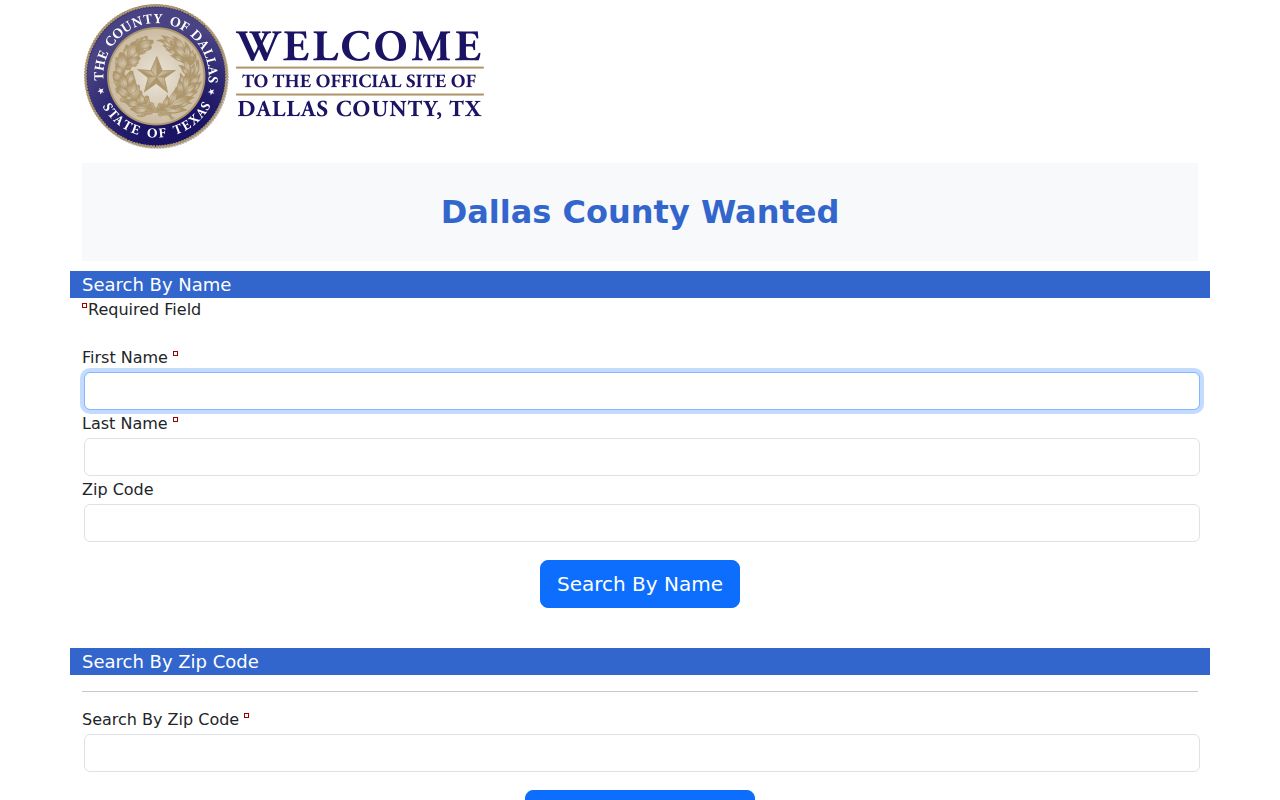
Search modes stay separate here: name, ZIP, case, citation, plate or VIN, and demographics each get their own screen. The Dallas County Wanted landing page posts its warning before any search begins.
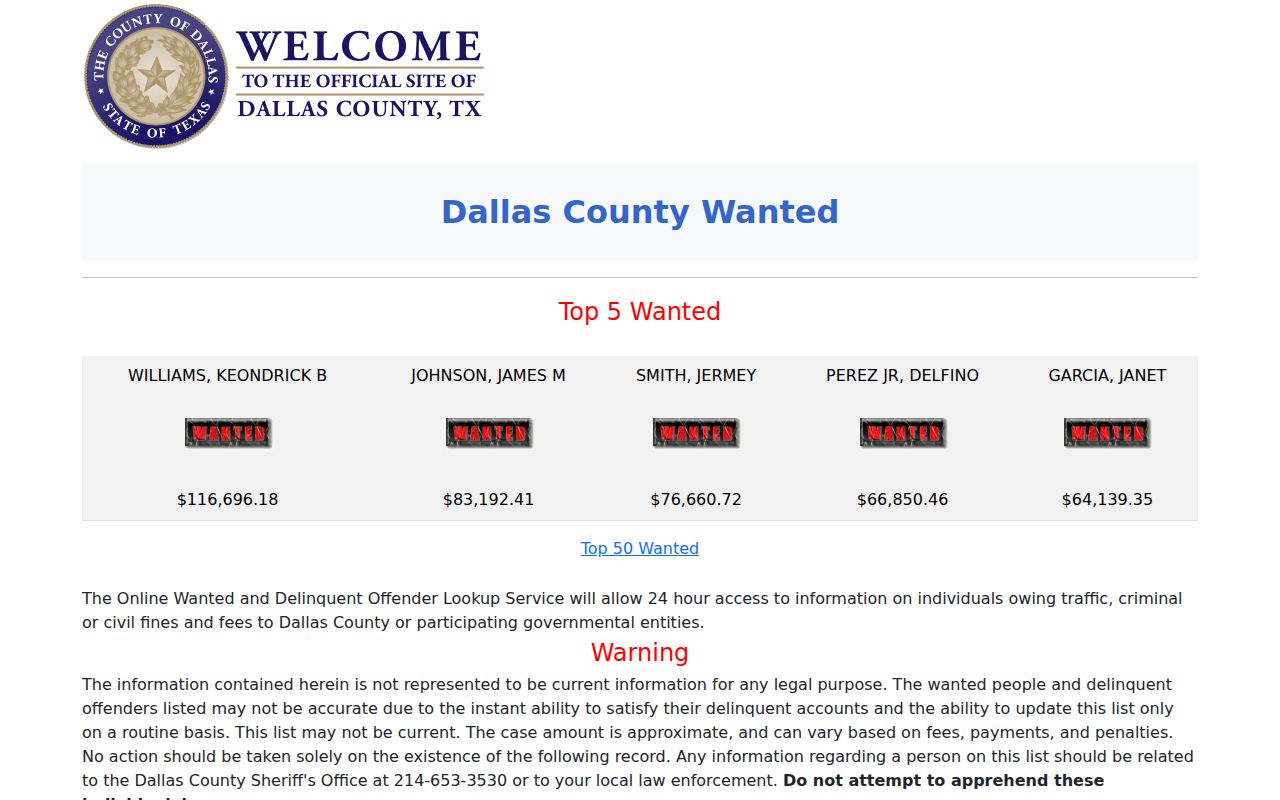
Read the county’s limits before treating any search entry as a confirmed court result.
Types of Warrants in Dallas County
Warrant labels in Dallas County mostly fall into four kinds. A probable-cause arrest warrant targets a person. A bench warrant follows a missed court setting, while an alias warrant issues when no first appearance has happened, and a capias pro fine comes after a judgment goes unpaid. A search warrant is different; it authorizes a search of a place or item, not an arrest. The label points you toward your next court contact, though only the issuing court can confirm the exact type.
| Warrant Type | How It Arises | Who Issues It |
|---|---|---|
| Arrest warrant | Probable cause supports taking a person before a magistrate. | Judge or magistrate in the case court |
| Bench warrant | A required appearance or court order was missed. | Judge overseeing the case |
| Alias warrant | No initial appearance or plea after a city citation. | Municipal Court |
| Capias pro fine | A judgment remains unsatisfied after a plea or finding. | JP or Municipal Court |
Route a Dallas County Warrant by Court Level
Court level decides where the file sits. The District Clerk keeps felony criminal records for seventeen District Courts, while the County Clerk’s Criminal Courts Division holds county misdemeanor records. Dallas County also runs ten Justice of the Peace courts, which handle much of the traffic and Class C caseload, and every city court keeps its own ordinance and municipal-citation files. Start from the county record-search hub to reach the right clerk tools. A Sheriff record request can show service or entry details, but the court alone controls a reset, a recall, a payment order, or bond. Keep this in mind: no countywide search merges all city and JP systems. For precinct matters, the county publishes a ten-court JP directory; match the citation to the precinct printed on it.
What a Dallas County Warrant Record Shows
A Dallas County warrant entry can carry a range of identifiers, but the public Wanted page shows no uniform record schema across courts. The county’s separate jail lookup may list a booked person’s charge, warrant number, bond amount, other holds, and the time the bond figure was valid. Note the distinction. A cause number and a warrant number are not always the same.
| Warrant or case number | Use the identifier shown by the issuing court; Dallas County has no single public format for every court. |
|---|---|
| Name and date | Check the match against your own notice and identity details. |
| Charge or reason | May describe the case or missed court duty; a flag alone is not the full order. |
| Issuing court | District, County Criminal, JP, or city Municipal Court. |
| Bond or balance | A bond is set by a court; the Wanted balance is approximate delinquent money. |
| Status | Active, served, recalled, or cleared can depend on the system displaying it. |
Why Dallas County Search Results Can Miss a Warrant
An empty result does not settle anything. Dallas County warrants can be missed for simple reasons: the warrant was just issued, it belongs to a city or JP court, the name carries a different spelling, or the record is sealed or protected. A court can also recall a warrant before any list catches up. Dallas County itself calls its Wanted data routine-update information, so neither a hit nor a blank screen ends the question. For a felony, use the District Clerk’s felony records route. For a county misdemeanor, ask the County Clerk directly. The jail lookup covers custody only, and it cannot find anyone who has not been booked.
- Recalled
- The issuing court withdrew the warrant.
- Served
- An officer carried out the warrant action.
- Cleared
- The system says enforcement is resolved, though the case may continue.
Who Issues and Serves Dallas County Warrants
Dallas County courts and magistrates issue the warrants. Service falls to several offices. The Sheriff’s Warrant Execution Section locates and arrests wanted people countywide, serves mental-illness warrants, and handles high-risk service for local and federal agencies. Constables work process tied to their precincts, while city police and marshals stay inside their own city systems.
Dallas County Sheriff Warrant Execution Section
Frank Crowley Courts Building
133 N. Riverfront Boulevard, Dallas, TX 75207
(214) 761-9026
Dallas County Sheriff Will Not Demand Warrant Payment by Phone
Scammers pose as Dallas County deputies and demand warrant payment over the phone, usually through a prepaid card. The Dallas County Sheriff never calls residents to collect warrant money, so treat any such demand as fraud. Even a caller who recites your case or warrant number may be running a con. Hang up. Then dial a number you look up yourself: (214) 761-9026 for warrant information and (214) 761-9025 for jail information. The two lines serve different purposes. Never send money to a caller or trust a number pulled from a threatening message, and read the official Sheriff scam notice for the county's own warning.
What to Do If You Have a Dallas County Warrant
Start by learning which court issued the warrant. That court can say what comes next: a payment, a new setting, a cash or attorney bond, a motion, a walk-in docket, or a planned surrender. A lawyer can contact the court for you. No single Dallas County window handles every felony, misdemeanor, JP, and city warrant.
Important: Confirm the court, place, and bond plan with a lawyer or issuing court before appearing at a general law-enforcement office.
Dallas County Routes to a City's Walk-In Warrant Docket
In Dallas County, Mesquite Municipal Court keeps a walk-in warrant docket on Wednesdays, Thursdays, and Fridays, holidays aside. Check in between 8:30 and 8:55 a.m. Docket starts at 9 a.m. at 211 Municipal Way. The court says people may seek resolution without fear of arrest. Ability to pay gets reviewed too. The clerk window must finish the judge's order, and the city warns that leaving without signing can bring another arrest warrant. Mesquite clears only Mesquite cases. Nothing there recalls a Dallas County felony warrant or another city's warrant. Dallas held its Resolve Outstanding Citations event February 28 through March 12, 2026. It covered eligible Dallas Class C citations only. That event has passed, so watch the city court for a repeat instead of assuming amnesty across Dallas County; the Mesquite walk-in court instructions carry the current check-in rules.
Public Access to Dallas County Warrant Records
The Texas Public Information Act, Government Code Chapter 552, opens records held by public bodies, with exceptions. It does not force Dallas County to merge city and JP portals into one complete database. Target the agency or clerk that holds it. A warrant, service return, payment receipt, or signed recall order each fits. Ask for the document itself. Skip the summary.
Key Rules:
Texas Government Code Chapter 552 sets public-information rules and allows some records to be withheld.
Texas Code of Criminal Procedure Article 15.26 makes an arrest warrant and affidavit public after execution, subject to other limits.
Texas Code of Criminal Procedure Chapter 45A governs capias pro fine process, hardship review, and certain juvenile confidentiality.
Dallas County Public Access Has Specific Warrant Limits
Under Texas law, an executed arrest warrant becomes public, and some affidavits do too. Other records stay closed. An unexecuted warrant, a juvenile matter, an active investigation, or a protected mental-health record may be sealed, withheld, or redacted. So a blank search means little. The court may still hold a confidential record. Request the precise existing document from the office that keeps it. The Sheriff offers a written request form. It works through mail, fax, or GovQA. Identifiers like a case number, date, and record type help. The form is a records channel, not an emergency way to recall a warrant; the Sheriff explains its public-information request process, and the countywide portal serves other Dallas County offices.
Warrant Records by City in Dallas County
Five cities matter here. Dallas, Irving, Garland, Grand Prairie, and Mesquite each run a municipal court for city ordinance, traffic, and Class C matters. Their resident populations use the 2020 Census for a consistent ranking. A city warrant may not appear in the Dallas County search. Start with that city's court.
Dallas Warrant Records
1,304,379 in 2020 · City court handles Dallas citations.
Irving Warrant Records
256,684 in 2020 · Warrants + Compliance is the court route.
Garland Warrant Records
246,018 in 2020 · Marshal and court options differ by warrant type.
Grand Prairie Warrant Records
196,100 in 2020 · Search detail may require a citation or DL.
Mesquite Warrant Records
150,108 in 2020 · Alphabetic list and weekly walk-in court.