
Dallas County Active Warrants May Remain Listed Seven Business Days After Payment
Paid your ticket and still on the list? The county FAQ warns that a record may stay on the Dallas County Wanted website for at least seven business days after full payment. That lag is about display timing only; the court's warrant status is a separate question. Keep your proof of payment, confirm the case with the issuing court, and ask the Sheriff's Warrant Execution Section whether the county list has caught up. A vanished entry is not the same thing as the court order that recalls a warrant. The Dallas County Wanted FAQ publishes the removal instructions.
Active Warrants in Dallas County
For a countywide angle, Dallas County opens its public Wanted service to anyone. It pulls together warrant indicators, delinquent-offender records, and separate scofflaw information. Coverage is not total, though. Some city and JP warrants stay in local systems and never feed the county page. An entry flagged active or outstanding only means the system still treats the process as open, so ask the issuing court whether it was served, recalled, or cleared. The Sheriff's Warrant Execution Section finds wanted people and serves process across Dallas County, but it does not replace the clerk or the judge who controls the case. No current official total exists for active warrants countywide, so treat any published list as a sample, never a census.
Dallas County Active Warrant and Top 50 Lists Serve Different Purposes
Dallas County runs two very different products. The searchable Wanted page takes a name, ZIP, case number, citation, plate, or VIN, with filters. The Top 5 and Top 50 lists are curated and ranked by money. That visible balance can include delinquent amounts, not just an arrest-warrant bond, so the two tools answer different questions. Use the official Top 50 interface to understand the program and its fields, not to judge a personal case. The roster changes often. For your own matter, search the broader county service first, then call the court or the Sheriff. The page shows column labels without making itself a full court record.
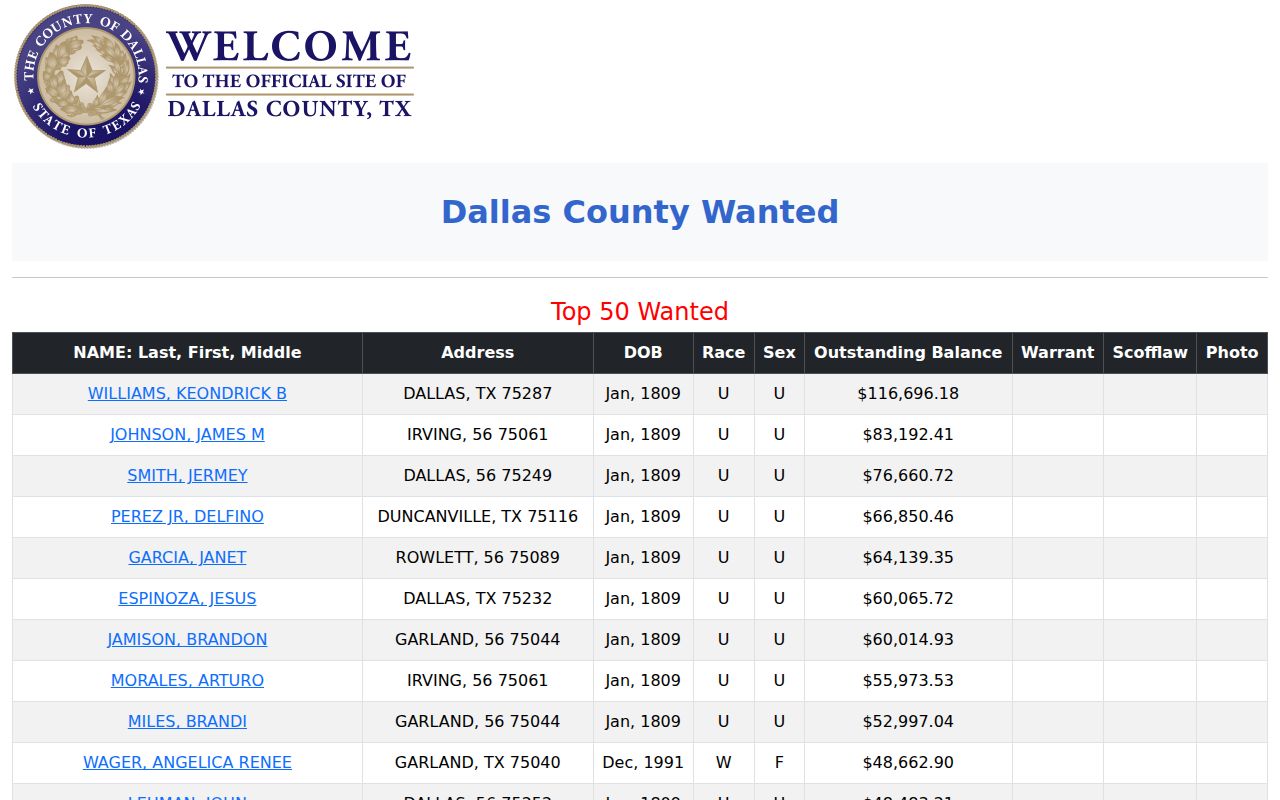
A balance or warrant flag needs direct confirmation before any payment or appearance.
How the Dallas County Active Warrant List Works
Dallas County says its Wanted information is refreshed on a routine basis, but it publishes no fixed daily or weekly schedule. A case can be paid or recalled before the page catches up, and a brand-new warrant may not be visible yet. So a Dallas County result is really a lead for a phone call. A blank search proves nothing either way; absence from the list does not mean no warrant exists.
Note: The Wanted FAQ says a paid record may take at least seven business days to leave the site; other court and agency systems can take a different amount of time.
Dallas County Active Warrant List Refreshes Can Lag Court Action
One timing fact comes straight from the county FAQ: after full payment, an entry can take at least seven business days to leave Dallas County Wanted. Note the limits. That clock belongs to that website, not to every city portal, court index, or law-enforcement system, and the page promises no update interval for new warrants. Suppose an order or receipt says your case is resolved while the list still shows it. Call the issuing clerk and ask when the Sheriff or other agency was notified, and hold onto the signed order, the payment receipt, and any confirmation number. A stale listing is a data problem for the source office to fix, not a clue about where the case stands in court. The Dallas County Wanted FAQ spells out the list-removal guidance.
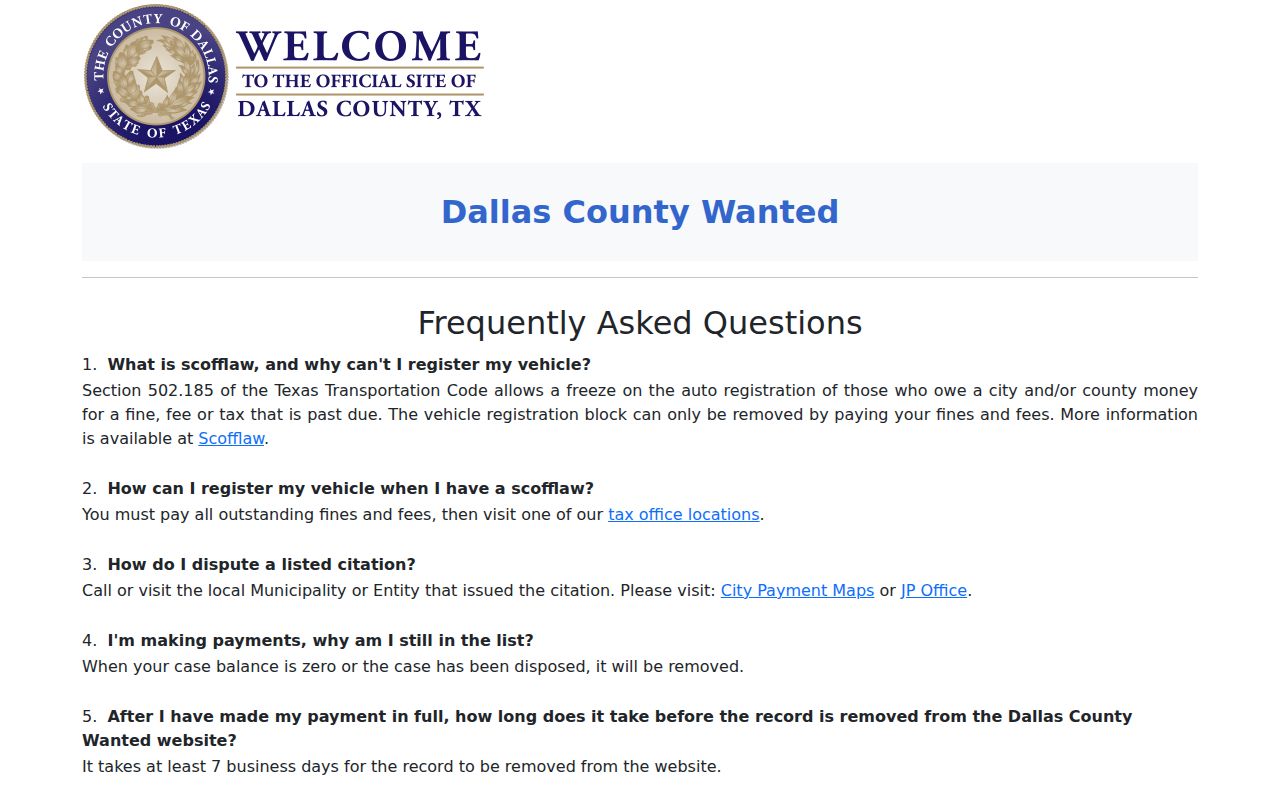
The FAQ gives a minimum removal interval, not a universal clearance clock.
What a Dallas County Active Warrant Shows
A public Dallas County entry can carry a name, a date or demographic details, an approximate balance, a warrant flag, or a scofflaw flag. That is about all. The public interface offers no complete field set for every court and no full status-code dictionary. A city record may call the matter alias, bench, or capias; a Sheriff list leans on broader categories.
| Warrant indicator | A flag that a warrant is associated with the entry; it is not the order itself. |
|---|---|
| Balance or amount | Approximate delinquent money, not automatically a bond. |
| Case identifier | Use the citation or cause number to ask the issuing court. |
| Court and status | May require direct confirmation; labels vary across systems. |
Dallas County Warrant Flags Differ From Scofflaw Notices
In the Dallas County Wanted interface, warrant and scofflaw indicators sit right next to delinquent amounts, which invites a misreading. A scofflaw block under Texas Transportation Code §502.185 concerns vehicle registration tied to past-due money. It is not an arrest order. A warrant flag, meanwhile, reveals no court-set bond, no judge, and no case history. Do not assume the dollar figure is what release costs. Ask the court whether a bond exists, whether it must be cash or surety, and whether a hearing or payment is required. The county's search form can point you to a record; the court supplies its legal status.
- Scofflaw
- A registration block tied to a past-due obligation.
- Bond
- A court-set condition for release or appearance.
- Outstanding balance
- Approximate delinquent money shown by a public list.
Most-Wanted Lists and Warrant Roundups
Dallas County publishes Top 5 and Top 50 wanted and delinquent-offender lists as a curated public-safety feature. A Dallas Municipal Court resolution event is a separate city process with narrow eligibility rules, not a countywide roundup or a standing amnesty program. Read the current notice before leaning on any event to address a Dallas County case.
Key Point: Dallas County Wanted publishes the official county search and curated lists. Open the county program page for current material.
Use the list as a pointer only, and confirm status with the issuing court or Sheriff.
Dallas County City Lists May Not Feed the Sheriff Search
Each city in Dallas County runs its own municipal court door. Garland, Grand Prairie, Mesquite, Irving, and Dallas each take a different route. Grand Prairie refreshes its citation and warrant search daily, except weekends. Mesquite labels its entries possible active warrants and posts an alphabetic list. So a blank result on one list settles little. A no-hit on Dallas County Wanted does not clear a city citation. A city hit, in turn, says nothing about a separate county case. Check the city court named on the ticket, and ask whether the Sheriff or another agency has received a clearance update; if a list conflicts with a court receipt, keep the receipt and ask the court which system still needs notice. For countywide list questions, contact the Sheriff Warrant Execution Section.
If Your Name Is on the List
First, confirm the entry is really yours. Then find the issuing court. For a Dallas County warrant, call the Sheriff. After that, reach the District Clerk, County Clerk, JP clerk, or city court that controls the case, and ask what comes next: a new setting, payment, bond, an attorney appearance, a motion, or a planned surrender. A lawyer can arrange the right route. Remember that a warrant can be recalled while the case itself stays open. Keep every order and receipt. Ask when local and state systems will show the change. Dallas County warns that list entries can lag, and no entry should be used to take action against another person.
Important: Contact the issuing court or a lawyer before making an appearance; an active warrant may be enforced during law-enforcement contact.