
Garland’s 24-Hour Drop Box Accepts Checks and Money Orders
Garland permits a check or money order to be mailed with a copy of the signer’s identification to the Municipal Court at 1791 W. Avenue B. Its 24-hour night drop box accepts checks and money orders, not cash or a card payment.
The city separately lists in-person payment and cash or attorney bond options. An online fine payment is not converted into a bond. Confirm which route applies to the case with the court before leaving payment or paperwork.
Use the Garland warrant instructions for the current court options.
How to Check for a Warrant in Garland
Garland’s official Warrant page explains its city categories and resolution choices, but it does not show a full search-field table. For a case-specific status, call Garland Municipal Court at (972) 205-2330. Use the citation or case number from the city notice and ask which category applies.
- Read Garland’s Warrant page for its alias, bench, and capias definitions.
- Call Municipal Court with the citation number and ask for the current case status.
- Use Garland Police Records for a police report or incident record.
- Ask whether a court visit, payment plan, bond, or marshal contact is required.
- Keep proof of payment or the judge’s signed order and confirm the city record was updated.
Garland Warrant Records Use Three City Labels
Garland defines an alias warrant as no initial appearance after a citation, a bench warrant as a missed scheduled date, and a capias as a judgment or plea followed by failure to pay the required fine. The category helps explain whether the next step may be a hearing, payment, or bond, but the court must confirm what is open in the case.
Read the city’s current warrant definitions and options before choosing a payment route.
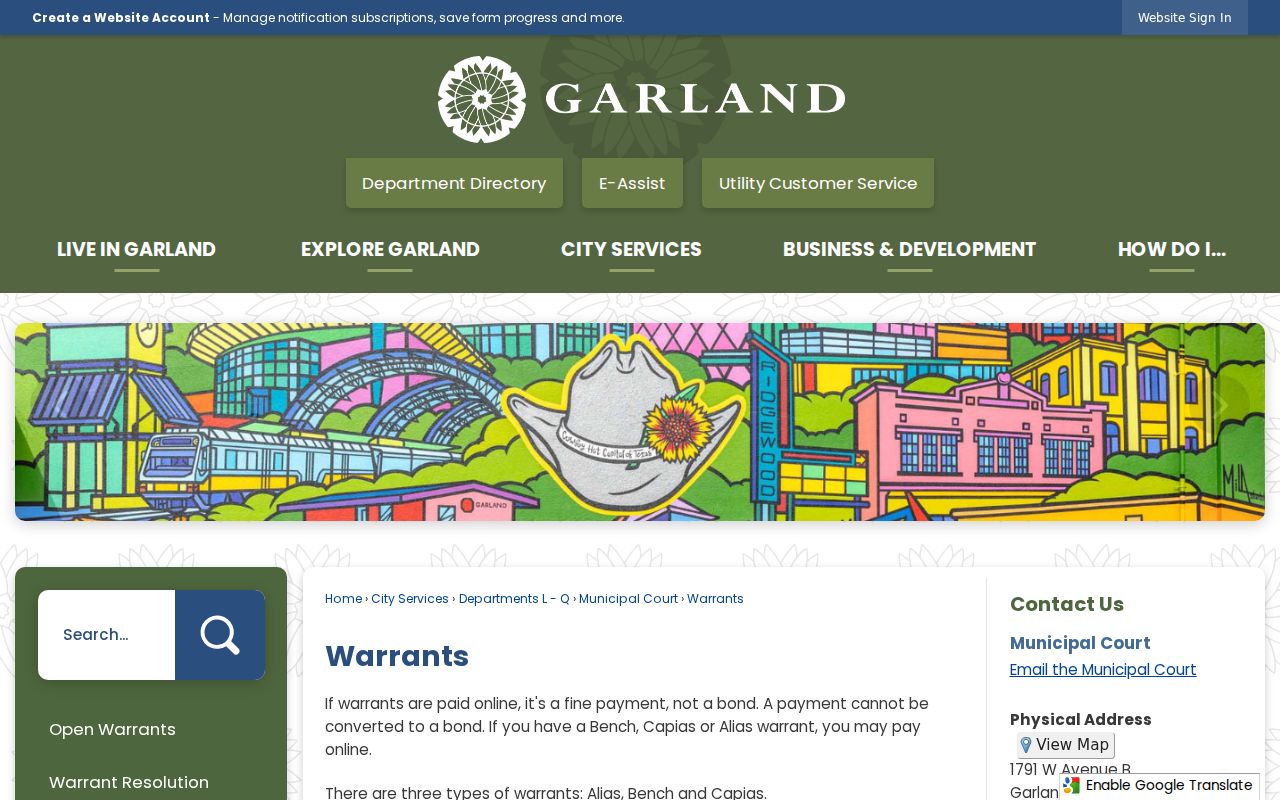
The official page separates the city’s alias, bench, and capias labels.
The Garland Police Department and Municipal Court
Garland Municipal Court is in the Brad Neighbor Municipal Court Building, 1791 W. Avenue B. Its main line is (972) 205-2330 and records line is (972) 487-7385; weekday hours are 8:30 a.m. to 4:30 p.m. The City Marshal at (972) 487-7342 executes misdemeanor arrest warrants and serves municipal-court orders.
Garland Police is a separate records route at 1891 Forest Lane. The court controls payment and case setting, while the marshal performs service and courtroom duties.
Garland Municipal Court
Brad Neighbor Municipal Court Building
1791 W. Avenue B, Garland, TX 75042
(972) 205-2330
Garland Fine Payment Is Not Bond
Garland states that paying online is a fine payment and cannot be changed into bond after the fact. A cash or attorney bond may set a court date; it serves a different purpose from satisfying a judgment. Before sending money, ask the clerk which option will resolve the warrant and whether a hearing is still needed.
The court accepts several payment routes, including in-person payment, mail, and its night drop box. The box is open around the clock but takes checks and money orders only. It is a delivery method, not a court appearance or live warrant confirmation.
See the city’s Garland payment and bond instructions.
Types of Garland Warrants
Garland’s three common city categories track different points in a municipal case. An alias follows no initial appearance; a bench warrant follows a missed setting; a capias follows judgment and unpaid fine. The city court’s label matters because an online fine payment, payment plan, or bond may not fit every type.
| Warrant Type | How It Arises | Who Issues It |
|---|---|---|
| Alias warrant | No initial appearance after a citation. | Garland Municipal Court |
| Bench warrant | Missed a scheduled Garland court date. | Garland municipal judge |
| Capias | Judgment or plea followed by unpaid fine. | Garland Municipal Court |
| Arrest warrant | Criminal process based on judicial review. | Magistrate or criminal court |
Garland Warrants Can Be Handled by the Marshal or Court
The Garland City Marshal executes misdemeanor arrest warrants, serves Municipal Court orders, and provides courtroom security. The court, however, decides the case, payment plan, or recall. A marshal service question and a court-resolution question are related but not the same request.
If an entry was cleared by the court but still appears in an agency queue, call the court and ask whether the marshal or law-enforcement record was notified. Garland’s older audit material described synchronization problems, so use the current court status rather than assuming a list has caught up.
The City Marshal role is described on Garland’s official office page.
What a Garland Warrant Record Shows
Garland’s public warrant material emphasizes the case category and resolution choices rather than a full searchable field table. Ask the court to confirm the citation, warrant type, amount due, and whether a hearing or bond remains open. Keep a receipt if payment was made through the portal or drop box.
| Citation or case number | Use the identifier printed on Garland's court notice. |
|---|---|
| Warrant label | Alias, bench, or capias, each with a different court posture. |
| Fine or cost | Ask whether the amount is a balance, collection cost, or bond. |
| Issuing court | Garland Municipal Court controls the city citation. |
| Status | Confirm the active, paid, recalled, or cleared state with the clerk. |
Garland Police Records Have a Separate Written Request Route
Garland Police Records and Open Records is at 1891 Forest Lane. The department accepts written requests through its JustFOIA portal, email, or the listed phone contacts. The city asks for details such as requestor, incident, date, file number, address, and involved person. It says response can take ten business days.
Request an existing police report or incident record; the department does not have to create a new legal analysis or warrant opinion. Court records belong with Garland Municipal Court. The request page notes copying fees and an estimate when costs exceed $40.
Use Garland’s Police Records Division page or its official request portal.
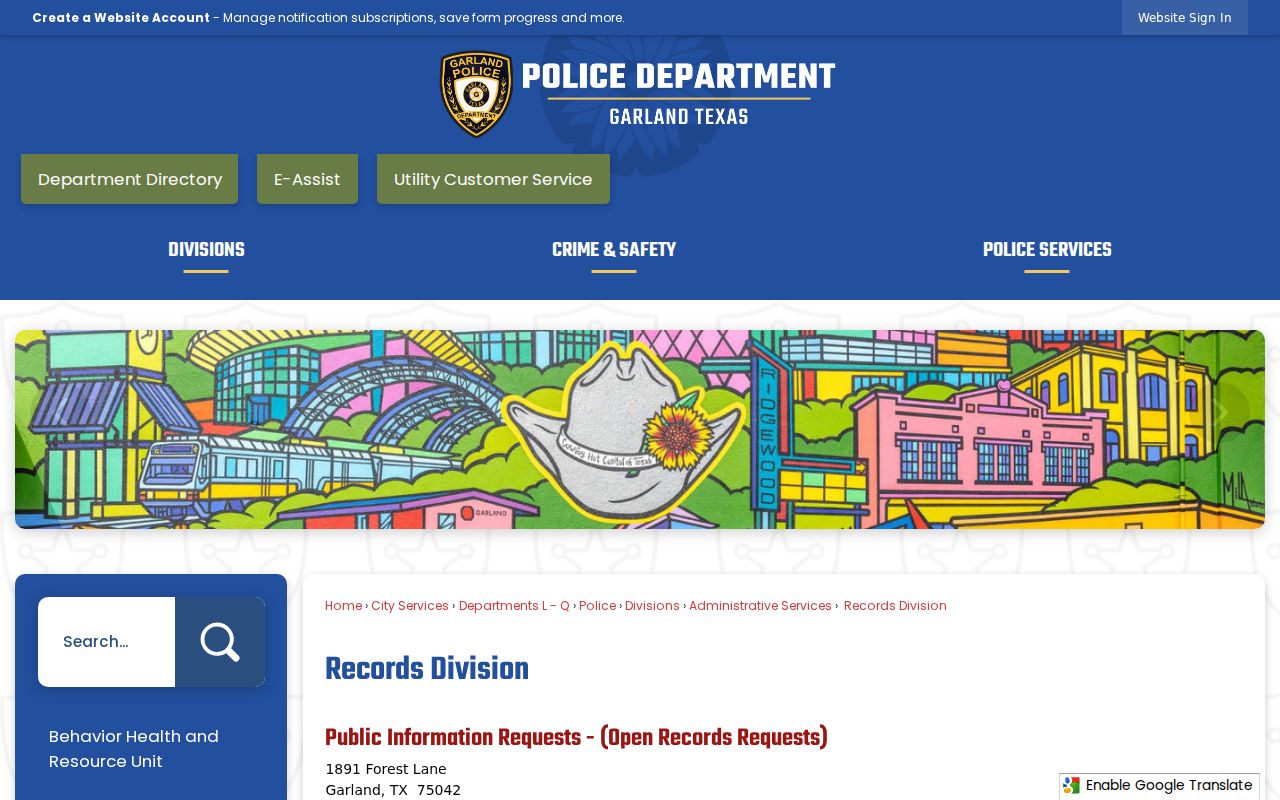
The request page routes police records, while the Municipal Court holds the citation case.
Where Garland Warrants Fit With Dallas County
Garland Municipal Court and City Marshal handle the city’s citation and service route; the Dallas County Sheriff is a separate county channel, and Texas has no public statewide warrant search. For the broader court and Sheriff paths, see the Dallas County warrant records overview and its county search instructions.
Garland Warrant Help Includes a Court Visit for People Who Cannot Pay
Garland says a person who cannot pay the full amount may come to court to discuss alternatives without fear of arrest. Alias and bench cases may qualify for a payment plan after staff review ability to pay; a capias must be resolved first. Ask the clerk which type is on the file before going.
The city also lists marshal or warrant-officer surrender and a detention-center route, plus cash or attorney bond to set a date. The court counter at 1791 W. Avenue B is distinct from the detention facility at 1891 Forest Lane.
Confirm current instructions on the Garland warrant page.

Garland Police is the city agency channel, while the Municipal Court directs resolution choices.
Public Access to Garland Warrant Records
Texas public-information rules cover city-held records, subject to exceptions. A Garland court entry, police report, juvenile record, or open investigation may have different access limits. Request the specific existing record from the office that holds it; a public city page does not promise that every warrant or case document is online.
Key Rules:
Texas Public Information Act, Government Code Chapter 552 governs access to many city records, subject to exceptions.
Code of Criminal Procedure Article 15.26 addresses access to executed arrest warrants.
Chapter 45A includes limits for qualifying juvenile fine-only records.